Friday, October 10, 2014
Perspectives
As a reporter of history, how did your perspective influence the way you depicted history? Answer thoroughly in 3-5 sentences.

Thursday, October 9, 2014


The Childhood Of A Serial Killer(Genghis Khan) Genghis Khan,originally named Timujin, had a very rough childhood because from a early age he was forced to the brutality of the Mongolian Steppe.The Rival Tatars poisoned and killed his father which left his mother to take care of her seven children alone.Genghis grew up hunting and may have killed his half-brother in dispute for food.During his teenage years,rival clans kidnapped him and his young wife and he spent time as a slave before escaping.By his early 20s he had established as a formidable warrior and leader.By 1206, he had succesfully consolitated the steppe confederations under his banner and began to turn his attention to the outside conquest. Genghis Khan's childhood affected his future because he wanted revenge.His revenge was to kill everyone, his revenge was so bad that he is responsible for the deaths of as many as 40 million people.That's 11 percent of the world!
The Great Khan
There was once a great hero named Temujin. He was a Mongolian leader. Temujin, also known as Genghis Khan, united Mongolian people, and started to conquer Asia. His father was poisoned by his tribe and his family was expelled from the tribe. Genghis grew up in a "survival mode".
He went back to the tribe that had kicked his family out, to take REVENGE on his fathers death. he made leaders of his enemies. He killed many people. Ganghis Khan was responsible for the deaths of as many as 40 million people on his conquest.
He went back to the tribe that had kicked his family out, to take REVENGE on his fathers death. he made leaders of his enemies. He killed many people. Ganghis Khan was responsible for the deaths of as many as 40 million people on his conquest.


Genghis the Warrior
 We really don't know about Genghis chilhood but we do know that when he was nine, his father was poisoned and they expelled him from the tribe. He grew up by hunting and surviving. In the early 20s he wanted revenge because they killed his father. Genghis established a warrior and leader ,and he successfully conquered the Mongol tribe.
Genghis killed over forty million people while fighting. During his empire he developed many ways to conquer. He developed the seige warfare and pretend retreat.Some people say he died from injuries because he fell from a horse, but no one knows where he was buried.

The Great Warrior
In 1192 Temujin was born of a Mongolian chief. We don't know much about his childhood but we do know that we was 9 years old his father was poised by an enemy tribe. He had a rough time growing up and trying to survive. He killed one of his half brothers in order to survive. Later on, he runs away leaving his poor mother with 7 children. After wondering a few years, he returns to his tribe, and avenges his father's murder.
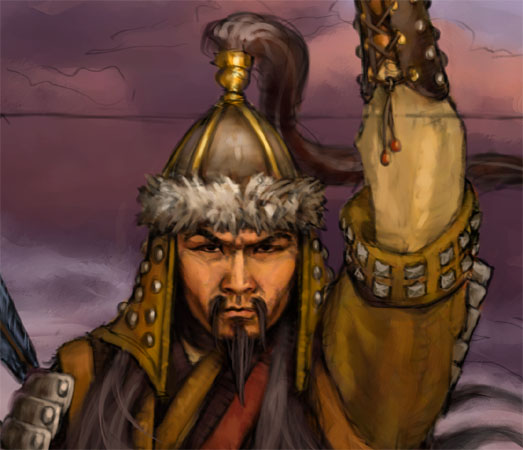
 In 1206 he became the supreme leader of all tribes. His name was changed to Genghis Khan ,which means great ruler. He also unified the Mongol tribes. He was a great conqueror and a great battle strategist. Two strategies are pretend retreat, and siege warfare. During his conquest his name was famously feared thought the land. Genghis Khan is the role model for Mongolians, but a monster to us.


Ghengis Khan conquered nearly 12 million square miles of territory- more tan any individual in history. He modernized Mongolian culture, embraced religious freedom, and helped open contact between east and west.
He was born along the Banks of the Onon River. His original name was Temujin. He was proclaimed Ghegis Khan until 1206 when he was proclaimed leder f the Mongols. Ghenis was forced to contend with the brutality of the Mongolian Steppe. The Tartars killed his father and there he promised to take revenge of his fathers death. He usually promoted his officers on skill ad experience rather thn class, ancestry or even past allegiances. He was responsable for the deaths of as many 40 million people. He was tolerant of different reigions. Ghengis Khan created one of the first international postal sysytem.
Nobody knows how he died or were he is buried. Some people think he died in 1227from injuries sutained in fall from a horse. The Soviets tried to snuff out his memory In Mongolia.
He was born along the Banks of the Onon River. His original name was Temujin. He was proclaimed Ghegis Khan until 1206 when he was proclaimed leder f the Mongols. Ghenis was forced to contend with the brutality of the Mongolian Steppe. The Tartars killed his father and there he promised to take revenge of his fathers death. He usually promoted his officers on skill ad experience rather thn class, ancestry or even past allegiances. He was responsable for the deaths of as many 40 million people. He was tolerant of different reigions. Ghengis Khan created one of the first international postal sysytem.
Nobody knows how he died or were he is buried. Some people think he died in 1227from injuries sutained in fall from a horse. The Soviets tried to snuff out his memory In Mongolia.
Wednesday, October 8, 2014
Coffee with the Khan
Imagine you are a news reporter in a coffee shop enjoying a smoothie with Genghis Khan (don't worry, he is unarmed and wants to speak with you). As the two of you discuss his life, he gives you the following statements:
"I am the punishment of God...If you had not committed great sins, God would not have sent a punishment like me upon you."
--Genghis Khan
"If you're afraid - don't do it. If you're doing it - don't be afraid."
--Genghis Khan
"An action committed in anger is an action doomed to failure."
Document your dialogue with the Khan. Choose one of the quotes and compose several interview questions. Teams to compose questions: Gadget, Pages, and Moderation
The Design and Promotion teams will answer the questions as Genghis Khan would answer based upon what we learned about him in our text book and the "10 Facts Page." Be sure your responses are thorough!
Mrs. Kane
"I am the punishment of God...If you had not committed great sins, God would not have sent a punishment like me upon you."
--Genghis Khan
"If you're afraid - don't do it. If you're doing it - don't be afraid."
--Genghis Khan
"An action committed in anger is an action doomed to failure."
Document your dialogue with the Khan. Choose one of the quotes and compose several interview questions. Teams to compose questions: Gadget, Pages, and Moderation
The Design and Promotion teams will answer the questions as Genghis Khan would answer based upon what we learned about him in our text book and the "10 Facts Page." Be sure your responses are thorough!
Mrs. Kane
Tuesday, October 7, 2014
Civilization #1
If you ran a country, what might lead you to govern well or become corrupt? Is corruption an inevitable consequence of power?
Civilization #3
Would you make a lot of laws or not many laws at all if you ruled a civilization? Why or why not?
Civilization #5
How does religion or ethnicity affect your life and the lives of your people? How has it affected governments of the past?
Civilization #6
What do you think is most important for a government to focus on: military defense, artistic accomplishment, or economic strength? Why?
Monday, October 6, 2014
Explorer or Settler?
Today we talked about the positive and negative aspects of being an explorer and a settler. If you had a choice, which would you be and why?
In your comments, begin with "I would prefer to be an explorer because..." or "I would prefer to be a settler because..."
Mrs. Kane
In your comments, begin with "I would prefer to be an explorer because..." or "I would prefer to be a settler because..."
Mrs. Kane
Contact us
Hey guys! You can always be in contact with us by sending us comments in this blog. You can also contact us by sending us emails (khk3580402@gmail.com.)
Remember that you can also come to our school Nicaragua Christian Academy International to meet us. Thanks for everything.
 |
Group 1: Angé
Why do We Study History?
History is the
window into the past. If we understand the past, we can understand the present.
It helps us to keep us informed on current event, appreciate multiple
perspectives and interpretation, and trains us to gather evidence and to find
patterns and trends. We can analyze history and strengthens our critical
thinking skills. It gives us to understand of other people in culture, the
excitement of discovery, the reward of solving world’s problem, and it challenges
us to think outside and think creatively.
History is FUN!!!
 Group 1: Julie
Group 1: Julie
Friday, October 3, 2014
Why Study History?
In the video we watched in class today, we learned that studying history has many benefits. In one or two sentences, why do you think it's important to study history?
Mrs. Kane
http://www.teachertube.com/video/why-study-history-191139
Mrs. Kane
http://www.teachertube.com/video/why-study-history-191139
Wednesday, October 1, 2014
Who Makes History?
A Worker Reads History
By: Bertolt Brecht
Who built the seven gates of Thebes?
The books are filled with names of kings.
Was it the kings who hauled the craggy blocks of stone?
And Babylon, so many times destroyed.
Who built the city up each time? In which of Lima's houses,
That city glittering with gold, lived those who built it?
In the evening when the Chinese wall was finished
Where did the masons go? Imperial Rome
Is full of arcs of triumph. Who reared them up? Over whom
Did the Caesars triumph? Byzantium lives in song.
Were all her dwellings palaces? And even in Atlantis of the legend
The night the seas rushed in,
The drowning men still bellowed for their slaves.
Young Alexander conquered India.
He alone?
Caesar beat the Gauls.
Was there not even a cook in his army?
Phillip of Spain wept as his fleet
was sunk and destroyed. Were there no other tears?
Frederick the Greek triumphed in the Seven Years War.
Who triumphed with him?
Each page a victory
At whose expense the victory ball?
Every ten years a great man,
Who paid the piper?
So many particulars.
So many questions.
The books are filled with names of kings.
Was it the kings who hauled the craggy blocks of stone?
And Babylon, so many times destroyed.
Who built the city up each time? In which of Lima's houses,
That city glittering with gold, lived those who built it?
In the evening when the Chinese wall was finished
Where did the masons go? Imperial Rome
Is full of arcs of triumph. Who reared them up? Over whom
Did the Caesars triumph? Byzantium lives in song.
Were all her dwellings palaces? And even in Atlantis of the legend
The night the seas rushed in,
The drowning men still bellowed for their slaves.
Young Alexander conquered India.
He alone?
Caesar beat the Gauls.
Was there not even a cook in his army?
Phillip of Spain wept as his fleet
was sunk and destroyed. Were there no other tears?
Frederick the Greek triumphed in the Seven Years War.
Who triumphed with him?
Each page a victory
At whose expense the victory ball?
Every ten years a great man,
Who paid the piper?
So many particulars.
So many questions.
Subscribe to:
Comments (Atom)